Haven
Legislation tracker

The law is finally catching up to your family

For twenty years the internet grew up unsupervised. That era is ending — quietly, one statute at a time. Here is the plain-language record of what has actually passed, what the courts have undone, and what is moving right now.

0
laws in force
0
bills moving
0
states represented
0
tracked in total
Straight from the record

The laws themselves, as filed

Not our summary of them — the actual bill pages, chaptered text, and Federal Register notices. Every card below links out to its primary source, so you can always check our work.

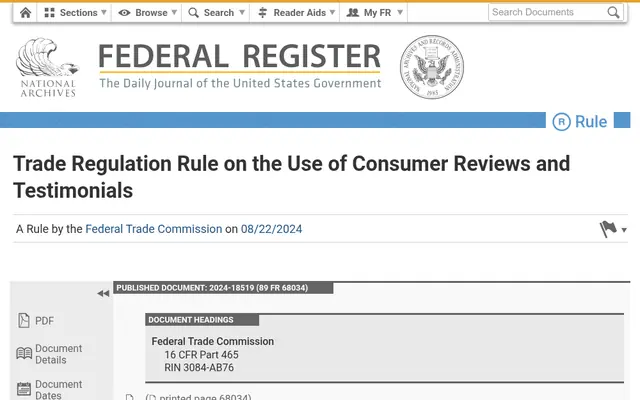
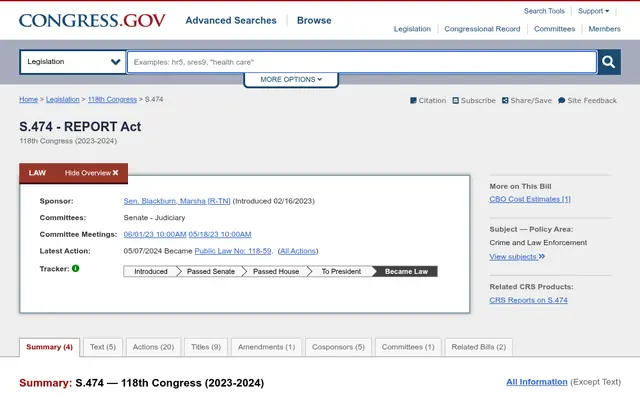
Congress.gov page for S.146, the TAKE IT DOWN Act, showing the LAW banner and the Became Law tracker TAKE IT DOWN Act Congress.gov · May 2025 Chaptered text of California Senate Bill 976, Chapter 321, approved by the Governor Protecting Our Kids from Social Media Addiction Act California Legislative Information · Sep 2024 Florida Senate page for CS/CS/HB 3, Online Protections for Minors, showing its effective date and chapter number Florida Online Protections for Minors The Florida Senate · Mar 2024 Federal Register notice for the FTC's amended Children's Online Privacy Protection Rule COPPA Rule Amendments Federal Register · Apr 2025 Federal Register notice for the FTC's trade regulation rule on consumer reviews and testimonials FTC Fake Reviews Rule Federal Register · Oct 2024 Congress.gov page for S.474, the REPORT Act REPORT Act Congress.gov · May 2024
Status Topic
Where

Protecting families online

Age checks, algorithmic feeds, app-store consent, AI companions, and the removal of intimate images — the rules now shaping the internet your children actually use.

ALABAMA HB 161 Feb 2026 ENACTED
Enacted Alabama Families Feb 2026

Alabama App Store Accountability Act (HB 161)

Signed February 2026; takes effect January 2027

Alabama became the fourth state to require app stores to verify user ages, tie minors' accounts to a parent, and get verifiable parental consent before kids download apps or make purchases. It passed the Alabama House 103-0.

What it means at your kitchen tableOne of the newest signs this model is spreading fast: starting in 2027, Alabama parents get a built-in approval step for everything their kids install or buy on a phone.

Read the source
CALIFORNIA SB 243 Oct 2025 ENACTED
Enacted California Families Oct 2025

California Companion Chatbot Safeguards Act (SB 243)

Signed October 2025; in effect since January 2026, some provisions phase in through 2027

The nation's first law regulating AI companion chatbots. Chatbots must clearly remind minors they're talking to an AI, must not expose them to sexual content, and must detect signs of self-harm and point kids to crisis help — with a private right to sue violators.

What it means at your kitchen tableIf your child confides in an AI friend, that AI now has legal duties in California — to be honest about what it is, keep things age-appropriate, and respond safely if your kid is struggling.

Read the source
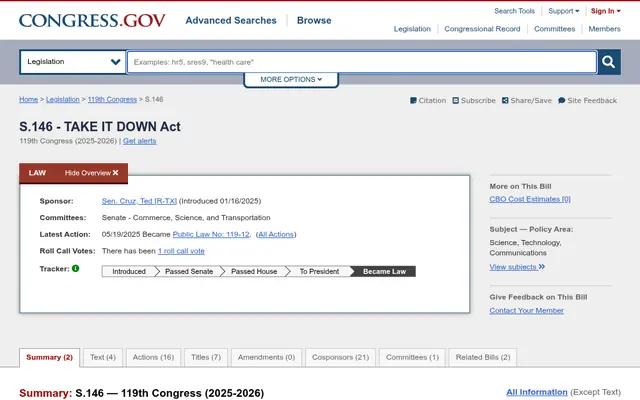
Congress.gov page for S.146, the TAKE IT DOWN Act, showing the LAW banner and the Became Law tracker Congress.gov
Enacted Federal Families May 2025

TAKE IT DOWN Act (S. 146)

Signed May 2025; fully in effect — FTC platform takedown enforcement began May 2026

Makes it a federal crime to post real or AI-generated intimate images of someone without their consent, including deepfakes of minors. Every major platform must offer a simple removal request and take the image down within 48 hours, with an FTC complaint portal behind it.

What it means at your kitchen tableIf a teen is ever targeted with a fake or leaked intimate image, parents have a fast, legally backed way to force it offline — no lawyers required.

Read the source
TEXAS SB 2420 May 2025 ENACTED
Enacted Texas Families May 2025

Texas App Store Accountability Act (SB 2420)

Signed May 2025; enforceable since June 2026 after the Supreme Court declined to block it

Apple's and Google's app stores must check every user's age, link a minor's account to a verified parent, and get the parent's okay before the child downloads apps or makes in-app purchases. A court fight continues, but the law is live.

What it means at your kitchen tableFor Texas families, app downloads and in-app spending by kids now route through the parent by default — the gatekeeping happens at the store, not app by app.

Read the source
VIRGINIA SB 854 May 2025 ENACTED
Enacted Virginia Families May 2025

Virginia Social Media Time-Limit Law (SB 854)

Enacted May 2025; enjoined by a federal court February 2026 — Virginia is appealing

A first-of-its-kind law capping social media at one hour per app per day, by default, for users under 16 — parents can raise or lower the limit. A federal judge blocked it on First Amendment grounds shortly after it took effect.

What it means at your kitchen tableThe boldest attempt yet to put screen-time limits into law rather than leaving them to parental-control apps — its appeal will shape whether other states can follow.

Read the source
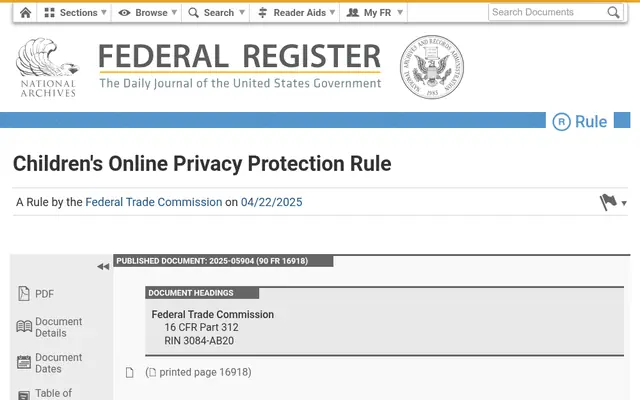
Federal Register notice for the FTC's amended Children's Online Privacy Protection Rule Federal Register
Enacted Federal Families Apr 2025

COPPA Rule Amendments (FTC Final Rule)

Effective June 2025; full compliance required since April 2026

The first update to children's online privacy rules since 2013. Apps and sites aimed at kids under 13 need separate parental permission before sharing a child's data with advertisers, can't keep kids' data indefinitely, and must protect categories like biometric data.

What it means at your kitchen tableThe apps and games your under-13 kids use can no longer quietly feed their data to ad networks — you have to say yes first, and you can say no.

Read the source
UTAH SB 142 Mar 2025 ENACTED
Enacted Utah Families Mar 2025

Utah App Store Accountability Act (SB 142)

Signed March 2025 — first in the nation; key requirements take hold May 2027 after 2026 amendments

The first state law making app stores — not individual apps — verify every user's age and get parental consent before minors download apps or spend money in them. 2026 amendments shored it up legally, and the tech industry dropped its lawsuit.

What it means at your kitchen tableUtah invented the check-ages-at-the-app-store model that Texas, Alabama, and others copied — by mid-2027, Utah parents will approve every app their kids install.

Read the source
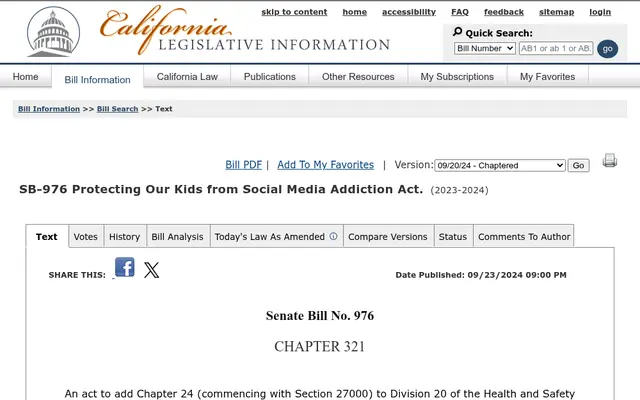
Chaptered text of California Senate Bill 976, Chapter 321, approved by the Governor California Legislative Information
Enacted California Families Sep 2024

Protecting Our Kids from Social Media Addiction Act (SB 976)

Signed Sept 2024; core addictive-feed provisions upheld and enforceable, compliance rules issued May 2026

Stops platforms from serving algorithm-driven addictive feeds to minors without a parent's consent — kids get chronological feeds instead — and blocks notifications to minors overnight and during school hours by default.

What it means at your kitchen tableThe infinite, personalized scroll that keeps kids up at midnight is switched off by default for California minors, and you decide whether to turn it back on.

Read the source
NEW YORK S7694A Jun 2024 ENACTED
Enacted New York Families Jun 2024

New York SAFE for Kids Act (S7694A)

Signed June 2024; final rules released July 2026, taking effect January 2027

The first state law targeting algorithmic feeds for minors: platforms must confirm ages and get a parent's consent before giving anyone under 18 a personalized feed, and can't send kids notifications between midnight and 6 a.m. without parental sign-off.

What it means at your kitchen tableStarting January 2027, New York teens get chronological feeds and quiet nights by default — the addictive version requires your permission.

Read the source
Congress.gov page for S.474, the REPORT Act Congress.gov
Enacted Federal Families May 2024

REPORT Act (S. 474)

Signed May 2024; in effect

Tightens the pipeline between tech platforms and the National Center for Missing & Exploited Children: platforms must report child trafficking and online enticement — not just abuse images — keep evidence for a full year, and face bigger penalties for failing to report.

What it means at your kitchen tableWhen something terrible is reported about a child online, the evidence now sticks around long enough for police to actually investigate, and platforms can't look the other way on grooming.

Read the source
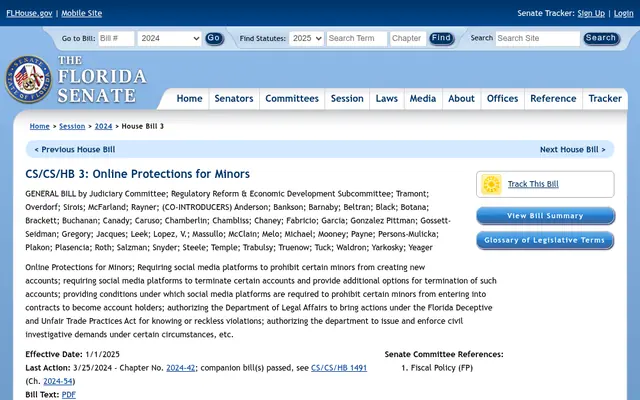
Florida Senate page for CS/CS/HB 3, Online Protections for Minors, showing its effective date and chapter number The Florida Senate
Enacted Florida Families Mar 2024

Florida Online Protections for Minors (HB 3)

Signed March 2024; enforcement allowed since November 2025 while appeal continues

Bans social media accounts for children under 14 and requires parental consent for 14- and 15-year-olds on platforms with addictive features, plus age verification on adult websites. After a year and a half in court, Florida is now enforcing it aggressively.

What it means at your kitchen tableIn Florida, platforms — not parents — now carry the legal duty to keep under-14s off social media entirely, one of the strictest rules in the country.

Read the source
TEXAS HB 1181 Jun 2023 ENACTED
Enacted Texas Families Jun 2023

Texas Adult-Site Age Verification Law (HB 1181)

Enacted 2023; upheld 6-3 by the U.S. Supreme Court in June 2025, fully enforceable

Requires pornography websites to verify visitors are 18 or older, with heavy fines for sites that don't. The Supreme Court's 2025 ruling upholding it green-lit similar laws now on the books in roughly half the states.

What it means at your kitchen tableThis is the decision that made age gates on adult sites the norm nationwide — a child with a phone can no longer click straight into hardcore content on major sites in most states.

Read the source
TEXAS HB 18 Jun 2023 IN PART
Partly in force Texas Families Jun 2023

Texas SCOPE Act (HB 18)

Enacted 2023; parental-tools requirements in effect, content-filtering provisions struck down

Requires social platforms to give parents real supervision tools over their minor children's accounts and limits how platforms can collect and use kids' data. Courts blocked the content-filtering mandates but the parental-control and data provisions stand.

What it means at your kitchen tableTexas parents are legally entitled to supervision tools on their kids' social accounts — even though the state's attempt to make platforms police content was struck down.

Read the source
FEDERAL S. 1748 Aug 2026 IN PROGRESS
Moving Federal Families Aug 2026

Kids Online Safety Act — KOSA (S. 1748)

Advanced unanimously by Senate Commerce in August 2026; heads to the floor, then reconciliation with the House package

KOSA would require platforms to turn on the strongest safety settings by default for minors and give parents tools to limit addictive features. Its duty of care would make platforms legally responsible for designs that harm kids — the provision the House version dropped, and the main fight left.

What it means at your kitchen tableParents would get default-on protections instead of hunting through settings, and platforms could be held accountable for endless scroll and algorithmic feeds shown to minors.

Read the source
FEDERAL S. 4407 Aug 2026 IN PROGRESS
Moving Federal Families Aug 2026

CHATBOT Act and the Senate kids-AI package (S. 4407)

Advanced by Senate Commerce August 2026 alongside KOSA; awaiting the floor

Part of the Senate's kids-AI package, it sets safety and transparency rules for consumer AI chatbots minors use, complementing the GUARD Act's outright ban on AI companions for kids.

What it means at your kitchen tableAI chat tools your kids encounter — in apps, toys, and homework helpers — would face federal safety requirements rather than today's patchwork.

Read the source
FEDERAL H.R. 7757 Jun 2026 IN PROGRESS
Moving Federal Families Jun 2026

KIDS Act — House kids-safety package (H.R. 7757)

Passed the House 267-117 in June 2026; awaiting Senate action

A package bill rolling 14 kids-online-safety proposals into one law: COPPA 2.0 privacy rules, parental controls on social media and games, limits on adult content, and AI chatbot disclosures for minors — with new protections for teens 14-17.

What it means at your kitchen tableIf enacted, every major platform, game, and chatbot your kids use would need real parental controls, no targeted ads to minors, and honesty about AI. Currently the most likely vehicle for federal kids-safety law.

Read the source
MULTI-STATE MANY STATES May 2026 IN PROGRESS
Moving Multi-state Families May 2026

The state app-store age-verification wave

Texas, Utah, Louisiana laws live in 2026; Alabama signed; bills active in a dozen more states

State laws making Apple's and Google's app stores verify every user's age and require parental consent before a minor downloads apps or spends money. After courts let the Texas law stand, roughly a dozen more statehouses are moving similar bills this year.

What it means at your kitchen tableIn affected states, parents approve every app a child downloads, with the app store doing the checking. Momentum is high — this is the fastest-spreading model in family-tech law.

Read the source
FEDERAL S. 3062 Apr 2026 IN PROGRESS
Moving Federal Families Apr 2026

GUARD Act — AI companions and minors (S. 3062)

Advanced unanimously by Senate Judiciary in April 2026; awaiting a floor vote

Would ban AI companion chatbots for anyone under 18, require age verification and repeated we-are-not-human disclosures, and create criminal penalties for bots that engage minors in sexual content or encourage self-harm.

What it means at your kitchen tableKids could no longer form relationships with AI companion apps, and every chatbot would have to check ages — the leading federal answer to California's already-enacted law.

Read the source
FEDERAL S. 836 Mar 2026 IN PROGRESS
Moving Federal Families Mar 2026

COPPA 2.0 (S. 836 / H.R. 6291)

Passed the Senate unanimously March 2026; House version folded into the KIDS Act — awaiting reconciliation

Updates the 1998 children's privacy law to cover teenagers, not just kids under 13: bans targeted advertising to minors and creates an eraser button letting kids or parents demand deletion of collected data.

What it means at your kitchen tableCompanies could no longer track and profile your teen for ad targeting, and families would get a legal right to wipe a child's data. The closest-to-passage item on this list.

Read the source

Fair and honest shopping

Hidden fees, fake reviews, subscription traps, anonymous sellers, and the quiet end of the duty-free loophole that made throwaway hauls so cheap.

CONNECTICUT S.B. 3 Jul 2026 ENACTED
Enacted Connecticut Shopping Jul 2026

Connecticut All-In Pricing Law (S.B. 3)

Signed June 2025; in effect since July 2026

Connecticut now requires advertised prices to include all mandatory fees, with violations actionable under the state's unfair trade practices act — part of a multi-state wave following California and Minnesota.

What it means at your kitchen tableConnecticut shoppers see honest up-front prices, and the state-by-state trend pressures national retailers toward all-in pricing everywhere.

Read the source
CALIFORNIA SB 707 Jul 2026 ENACTED
Enacted California Shopping Jul 2026

California Responsible Textile Recovery Act (SB 707)

Enacted 2024; producer registration required by July 2026, full program by ~2030

The first US law making clothing brands financially responsible for what happens to their products after use. Apparel producers selling into California must fund a statewide reuse, repair, and recycling program instead of letting fast-fashion castoffs go to landfill.

What it means at your kitchen tableOver time it raises the true cost of disposable fast fashion and will give families free drop-off options for worn-out clothes; brands that ignore it will be barred from selling in California.

Read the source
FEDERAL FEDERAL Aug 2025 ENACTED
Enacted Federal Shopping Aug 2025

End of the $800 duty-free import loophole

In effect since 2025; survived the Supreme Court tariff ruling; statutory repeal locks in July 2027

The loophole that let Shein, Temu, and similar sites ship packages under $800 into the US duty-free and nearly uninspected is gone. Sub-$800 parcels dropped by half within months, Temu shifted to US warehouses, and Congress made the repeal permanent from 2027.

What it means at your kitchen tableUltra-fast-fashion hauls are no longer artificially cheap, and packages face customs scrutiny — which also catches more counterfeit and unsafe children's products that used to slip through.

Read the source
CALIFORNIA AB 2863 Jul 2025 ENACTED
Enacted California Shopping Jul 2025

California Click-to-Cancel Law (AB 2863)

In effect since July 2025

Subscriptions must be as easy to cancel as they were to start: same-method cancellation, a click-to-cancel button online, clear disclosure before free trials convert to paid, and reminders before annual renewals.

What it means at your kitchen tableWith the federal rule vacated, this is the strongest active subscription-trap protection in the country — and it effectively covers most national streaming and app services families use.

Read the source
FEDERAL FTC RULE May 2025 ENACTED
Enacted Federal Shopping May 2025

FTC Junk Fees Rule

Final rule, in effect since May 2025

When you buy event tickets or book hotels and vacation rentals, the total price with all mandatory fees must be shown up front, not revealed at checkout. Drip pricing — a cheap-looking price that balloons with resort and service fees — is banned in those markets nationwide.

What it means at your kitchen tableFamilies comparing hotel or ticket prices can trust the first price they see; violators face penalties over $50,000 per violation.

Read the source
NEW YORK NEW YORK May 2025 ENACTED
Enacted New York Shopping May 2025

New York Buy-Now-Pay-Later Act

Signed May 2025; takes effect as state regulators finalize rules (in progress through 2026)

The first state law to comprehensively regulate BNPL lenders: licensing, monthly billing statements, late fees capped around $8, and a real dispute process — filling part of the hole left by the federal withdrawal.

What it means at your kitchen tableOnce the rules finalize, New York families get credit-card-like safeguards on pay-in-4 loans, and other states are watching it as a model.

Read the source
Federal Register notice for the FTC's trade regulation rule on consumer reviews and testimonials Federal Register
Enacted Federal Shopping Oct 2024

FTC Fake Reviews Rule

In effect since October 2024; enforcement warning letters began late 2025

It is now illegal to buy, sell, or fake product reviews, use AI-generated fake reviews, pay for positive ones, suppress negative ones, or fake follower counts — with fines over $50,000 per violation.

What it means at your kitchen tableThe star ratings families rely on when picking products are more likely to be genuine, and there's now a legal hammer against sellers who game them.

Read the source
CALIFORNIA SB 478 Jul 2024 ENACTED
Enacted California Shopping Jul 2024

California Honest Pricing Law (SB 478)

In effect since July 2024

Businesses selling to Californians cannot advertise a price that excludes mandatory fees — the advertised price must be the real price, except taxes and shipping. It covers hotels, ticketing, rentals, delivery apps, and most online purchases.

What it means at your kitchen tableCalifornia families see all-in prices across nearly every purchase — and because sellers rarely build California-only checkouts, many national sites adopted honest pricing for everyone.

Read the source
FEDERAL FEDERAL Jun 2023 ENACTED
Enacted Federal Shopping Jun 2023

INFORM Consumers Act

In effect since June 2023; actively enforced — Temu paid a $2 million penalty in 2025

Online marketplaces like Amazon, eBay, and Walmart must verify the identity of high-volume third-party sellers and disclose the seller's name and contact information to buyers, targeting counterfeiters who hide behind anonymous storefronts.

What it means at your kitchen tableWhen a family buys from a third-party seller on a marketplace, they can see who the seller actually is — making counterfeit and unsafe goods easier to avoid and trace.

Read the source
FEDERAL FTC RULE Mar 2026 VACATED
Struck down Federal Shopping Mar 2026

FTC Click-to-Cancel Rule — struck down, being rewritten

Vacated by the Eighth Circuit July 2025 on procedural grounds; FTC restarted rulemaking March 2026; enforcement continues under existing law, including Amazon's $2.5 billion Prime settlement

The federal rule that would have made canceling a subscription as easy as signing up was struck down before it took effect — not for what it said, but because the FTC skipped a required economic analysis. A replacement rule is being written, and the FTC keeps suing companies under existing law meanwhile.

What it means at your kitchen tableThere's currently no nationwide click-to-cancel requirement, so subscription traps remain legal friction in most states — though California's own law fills the gap for many services families use.

Read the source
FEDERAL CFPB RULE May 2025 WITHDRAWN
Withdrawn Federal Shopping May 2025

Federal Buy-Now-Pay-Later protections — withdrawn

2024 rule withdrawn by the CFPB in May 2025; no federal replacement planned

In 2024 the CFPB said buy-now-pay-later providers must give users credit-card-style protections — the right to dispute charges and get refunds for returns. In 2025 it withdrew that rule and said it won't replace it.

What it means at your kitchen tableFamilies using pay-in-4 at checkout currently have no guaranteed federal right to dispute a charge or get a refund credited — protections depend on the provider's own policies and state law.

Read the source
FEDERAL S. 2254 Jan 2026 IN PROGRESS
Moving Federal Shopping Jan 2026

Click to Cancel Consumer Protection Act (S. 2254)

Reintroduced January 2026 after courts vacated the FTC rule; pending in committee

Would make canceling a subscription as easy as signing up — one click, no phone-call mazes — and require consent before free trials convert to paid, with renewal reminders. Congress is acting because a court threw out the FTC rule that did the same thing.

What it means at your kitchen tableThe average family wastes about $200 a year on forgotten or hard-to-cancel subscriptions; this would end subscription traps nationwide.

Read the source
FEDERAL H.R. 1402 Apr 2025 IN PROGRESS
Moving Federal Shopping Apr 2025

TICKET Act (H.R. 1402 / S. 281)

Passed the House 409-15 in 2025; awaiting a Senate floor vote, widely expected to pass

Requires ticket sellers for concerts, sports, and events to show the full, all-in price — every fee included — up front in ads and search results, and bans selling tickets the seller doesn't actually have.

What it means at your kitchen tableNo more $35 tickets that become $60 at checkout; families could comparison-shop events honestly. The most likely consumer-shopping bill to become law.

Read the source

No laws match those filters yet. Try widening the search — or tell us what you wish existed.

By jurisdiction

Browse by state

Rules differ enormously depending on where you live. These pages collect what applies where you are.

Laws move slowly. Your household doesn't have to wait.

Every statute here makes the neighborhood a little safer — but none of them protect your family tonight. Haven does that part now, and when a company or provider falls short of these rules, Haven Voice helps you say so.